

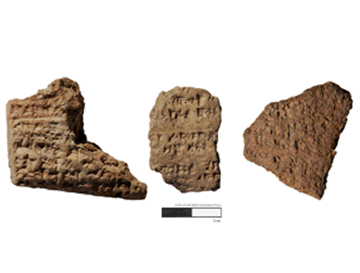
(Aug. 9) – Three fragmentary Hittite cuneiform tablets from the 13th century BC are the most important result achieved this year by the archaeological mission conducted by the University of Florence, in collaboration with the Museum of Yozgat, at the Uşaklı Höyük site, in Turkey. More than twenty archaeologists, students, graduates and doctoral students from the University of Florence, Pisa and Siena, led by Stefania Mazzoni, Professor of Archeology and History of the Ancient Near East at the University of Florence, have applied a new scarping technique on the slopes of the acropolis and have unearthed the remains of great palaces and a substantial quantity of Hittite and Phrygian materials. The findings document the long life of the city, built along the river, in a fertile valley dominated by the Hittite mountain Daha, today called Kerkenes Dağ. The fragments unearthed are a further step in proving the importance of Uşakli, around which the Hittites created a powerful kingdom from the 17th to the 12th century BC. (red)


