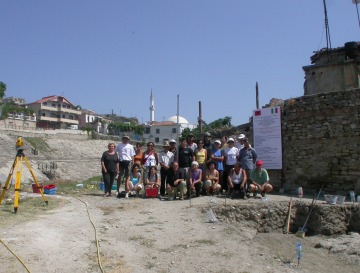
Mar. 10 – Eva Coïsson and Chiara Vernizzi, two professors from the Department of Civil Engineering, Environment, Land and Architecture, University of Parma, are leading an archeological mission aiming at the discovery, protection and enhancement of the architectural heritage and cultural assets. And thanks to a multidisciplinary approach and a strong collaboration between students and teachers, they are making history. They recently traveled to Tirana to take part in the round table “Know-Manage-Display,” in which they presented the Italy’s archeological research on Albania’s heritage. The two professors, in particular, presented the architectural surveys and projects for the conservation and restoration of the Roman amphitheater in Durres conducted within the Italian archaeological mission. “The material presented in Tirana is the result of over a decade of work on the Roman amphitheater. The woman behind everything is Professor Sara Santoro of the University G. D’Annunzio in Chieti -Pescara, who heads the Italian archaeological mission on this site,” explain the professors. “After a few years of excavations, in 2004, thanks to an international Ministry of Education project coordinated by Professor Paul Giandebiaggi, the Department of Civil Engineering, Environment, Land and Architecture of the University of Parma commenced its documentation and analysis activities. First – continue Coïsson and Vernizzi – the design and performance group, directed by Prof. Giandebiaggi, mapped with different techniques (from direct relief to the laser scanner) all the area. The amphitheater was incorporated into the urban fabric over the centuries, and until about fifty years ago all trace had been lost. The emphasis was not limited to the archaeological object itself, but also to the overlying and surrounding buildings, to figure out what still remains hidden and where to look. Then – say the professors – the restoration group, coordinated by Prof. Carlo Blasi, entered the scene to analyze and map structural instabilities, especially the degradation of materials, much accentuated by the water that collects naturally in this kind of reservoir. Overall, the experience was particularly rich and stimulating – conclude the professors, commenting on the human aspects of the mission – first of all for the opportunity to work in a new and particular context, but especially for the real interdisciplinarity of the adopted scientific approaches, which used relief, archeology, geology, restoration and urban planning throughout the course of the work to better understand the peculiarities of the amphitheater’s conditions. This was key to obtain a preliminary understanding as complete as possible that would allow us to make sound proposals for intervention and enhancement congruous with the amphitheater’s characteristics.” Also thanks to its multidisciplinary approach, the project was selected by the National Research Council in 2007 to be presented in Tokyo during the seminar “Information technology and cultural communication,” held at the Italian Cultural Institute by the National Research Council in collaboration with the Ministry of Foreign Affairs and other Italian entities as part of the ” Italian Spring in Japan.” “Another added value is certainly constituted by having Italian and Albanian students involved in the various missions, both undergraduates and doctoral students who worked with the teachers on the excavation operations, the architectural surveys and the preparation of proposals for conservation. In this case, we think we managed to strike a good balance between research and training,” conclude Coïsson and Vernizzi.

Durres’ Amphitheater in the spotlight thanks to professors at Parma University