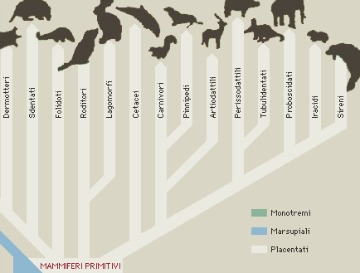
Dec. 31 – The Proceedings of the National Academy of Sciences (PNAS) is an important scientific journal of the US National Academy of Sciences, which has published scientific articles since 1915. It more recently published a study conducted by a group of complex system physicists from the University of Milan, led by Marco Gherardi, in collaboration with the INFN – Milan Section, the Centre National de la Recherche Scientifique and the Universities Pierre et Marie Curie and Harvard. Their work centered on a new interpretive hypothesis regarding the evolution of mammals. The Milan researchers identified two mathematical equations governing the evolution of the size of software packages that also effectively describe the evolution of mammal sizes. The study – relevant for the management of complex software projects – was conducted on Ubuntu, one of the most popular Linux distributions and open source systems, and in particular on the size of 300.000 changes occurring in software packages. The research identified two quantitative laws that govern the evolution of program sizes: large changes of scale, or multiplicative changes, and the maximum change limit reached based on the current size. The same laws that apply to the evolution of the Linux software packages have been successfully applied to the evolution of mammal masses, starting from small mammals from the Mesozoic. The study showed that the typical body size of a species, even if related to a number of other features, follows quantitative laws, particularly those relating to maximum size, which allow more accurate predictions on the mass of a species that can be reached by looking at the ancestors. The large amount of data available from software packages has been able to compensate for the scarcity of such data available for mammals, obtained with the discovery and dating of the extinct animals’ bones. “From Ubuntu – says Gherardi – we got the necessary interpretive tools, since data on the evolution of small mammals’ mass from the Mesozoic to the wide distribution of present sizes is scarce and difficult to obtain.” The body size of a typical species is a complex trait, related to many other features, such as metabolism, habitat, and life, but it also follows quantitative laws “Scientists already knew that mammal sizes followed multiplicative changes, but we have identified a second law – continued Gherardi – that allows to describe in a much more precise manner the available data, allowing more accurate predictions than previous ones. In particular, the application of the second law sets the limit to the mass that a species may reach in relation to the mass of the progenitor species.”

The new Harvard-Milan-Paris academic partnership